


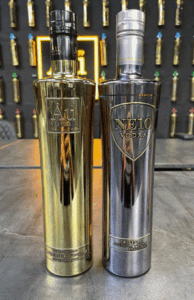
In Au Vodka Ltd v NE10 Vodka Ltd and another [2022] EWHC 2371 (Ch), the High Court rejected an application for an interim injunction in a passing off claim brought by Au Vodka Ltd based on the allegedly deceptively similar get-up of the claimant’s vodka and that of the defendants’ new range of NE10 vodkas.

AU Vodka v NE10 Vodka Passing Off Injunction
The High Court recently (16/22nd September 2022) refused an application for an interim injunction to prevent a new brand of Vodka from being sold.
The Claimant, AU Vodka, started in 2017 and saw massive growth since with the last financial year having sold £40m of its AU Vodka. It is an established player in the vodka market and does particularly well from its flavoured vodkas. It had celebrity endorsements and DJ Charlie Sloth is a shareholder.
AU Vodka became aware of a new entrant NE10 Vodka, selling bottles which look similar to theirs, when the Defendant’s owner/director posted an image on Instagram on 22nd August 2022 – shows you how quickly interim injunctions can get to court.
Although on the face of it, they do look similar, this (the Court held) was a matter for a Trial Judge to look at all the evidence and that it could go either way depending on that evidence.
The Judge in this case was careful to consider each of the above points with the limited information they have to hand at an injunction hearing. Remember, the Court will not have every single piece of evidence. The hearing lasted just 3 hours.
Mellor J said that there was plainly a serious issue to be tried on passing off and the case was finely balanced. The evidence which would emerge between now and trial could swing the case one way or the other. He held that there should be a trial as early as possible in January 2023, but refused to grant an interim injunction, reasoning that:
- There was a serious issue to be tried that the claimant had a reputation in the appearance of its product. However, the weight given to the various elements in the claimant’s identification of its get-up differed from the judge’s view that the most significant feature was the name “Au”, followed by the metallised gold bottle.
- Regarding misrepresentation, various instances of actual confusion relied on by the claimant, viewed in context, evidenced consumers wondering whether there was a connection between the vodkas, as opposed to actually believing that there was one. So, there were not instances of actual deception.
- Damages would be an adequate remedy for the claimant if no interim injunction was granted. While a small number of instances of deception could not be ruled out in the four months pending trial, any effect would be small and would be largely remedied by the grant of an injunction at trial and damages. Conversely, damages would not be an adequate remedy for the defendants if an interim injunction was granted, including because they would lose the momentum built up in the ongoing launch of their vodka products and would be likely to have to lay off new employees. The fact that the defendants’ products were on the market was the principal reason why the balance of convenience favoured the defendants.
Ultimately, the Judge refused the Claimant’s application for an interim injunction.
What is an interim injunction?
An injunction is an order of the court that requires a party either:
- To do a specified act (mandatory injunction).
- To refrain from doing a specified act (prohibitory injunction).
An injunction may be sought to, for example:
- Prevent anticipated wrongdoing (a quia timet injunction).
- Negate the benefit of wrongdoing (a springboard injunction).
The word “interim” means that it is enforced only until Trial and a final decision made. If the claimant/applicant is successful, then it will likely become a final injunction. If the claimant/applicant is unsuccessful at trial, then the injunction will be lifted and the claimant will have to pay the damages and costs of the other party.
- Applications for interim injunctions should be decided primarily on the balance of convenience, in the wider sense of that phrase, rather than on the relative strength of the parties’ substantive cases as they may then appear.
- There is no rule of law that the court may consider the balance of convenience only if satisfied that the claimant has made out a prima facie case.
- The court must, however, satisfy itself that there is a serious question to be tried.
- An interim injunction should be refused if damages awarded at trial would adequately compensate the claimant and the defendant will be able to pay.
- An interim injunction should be granted if the claimant’s cross-undertaking in damages would adequately compensate the defendant if successful at trial, and the claimant would be able to pay.
- If, as will normally be the case, damages would not fully compensate either party, then the issue depends on the balance of convenience.
- If other factors are finely balanced, the status quo should be maintained.
- If the balance of convenience favours neither party, then the relative strengths of the parties’ respective cases on the merits may be taken into account if one case is disproportionately stronger.