


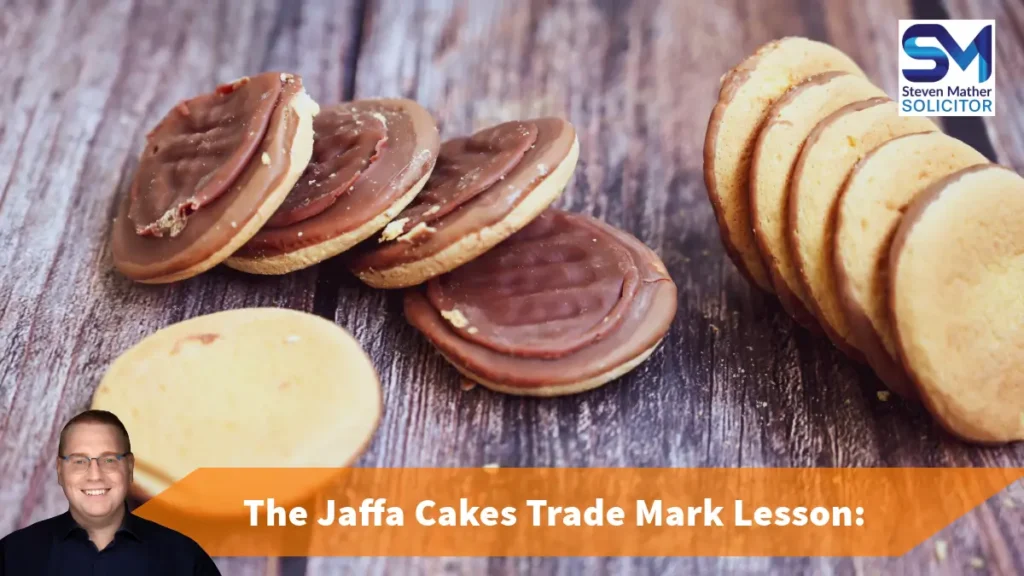
I was in the Co-Op the other day, and was surprised to see a ‘dupe’ Jaffa Cake box (I didnt call them dupes, my daughter did!). I wondered why Jaffa Cakes would let that happen.
Imagine inventing a product so popular that its name becomes a household word – and then discovering you don’t actually own that name. This is exactly what happened with McVitie’s Jaffa Cakes, one of Britain’s favourite treats. In this post, I explore how McVitie’s launched Jaffa Cakes in 1927 without registering the trade mark, why that mattered, and what lessons today’s business owners can learn from this sticky situation. We’ll keep it plain English (no dense legal jargon!) and give you a friendly heads-up on protecting your own brand names.
Meet McVitie’s and Their Jaffa Cakes
McVitie’s “The Original” Jaffa Cakes – a soft sponge base with orange jam and chocolate, first introduced in 1927. A beloved British snack, but the name itself wasn’t protected by a trade mark.
McVitie’s (originally McVitie & Price) is a well-known British biscuit and cake company with roots back to the 19th century. In 1927 they introduced a unique sweet snack called Jaffa Cakes, named after Jaffa oranges for its zesty orange jam filling. A Jaffa Cake is a small, circular cake with three layers: a sponge base, a tangy orange jelly centre, and a coating of chocolate on top. Over the years, Jaffa Cakes became wildly popular in the UK – so popular that people even debated whether they were actually cakes or biscuits. (Fun fact: in a 1991 tax case, a court ruled they are legally cakes – sparing them from VAT).
By all accounts, Jaffa Cakes were a huge success and an iconic McVitie’s product. But there was one big oversight: McVitie’s never registered “Jaffa Cakes” as a trade mark. In other words, although McVitie’s was the originator of Jaffa Cakes, it didn’t legally secure exclusive rights to that name.
Trade Mark Basics
So, what is a trade mark? In simple terms, a trade mark is basically a registered brand name or logo. It’s a way for a business to protect the names and symbols that distinguish its products or services. By registering a trade mark, you get the exclusive right to use that name for the goods or services in question – and you can stop others from using it (or anything confusingly similar). For example, if you trademark your product’s name, competitors can’t sell their own versions using that name. It’s one of the key tools to build and safeguard a brand’s identity.
A couple of quick points on trade marks in plain English:
- Registering a trade mark means officially recording it with the relevant authorities (like the UK Intellectual Property Office) to get legal protection. Think of it as “reserved” for your business.
- Trade marks should be distinctive – a made-up or unique name is easiest to protect. Generic or descriptive terms (like “Chocolate Cake”) usually can’t be trade marked on their own because everyone needs to use those words. The more unique your product name, the stronger the trade mark.
- Once you have a registered trade mark, you can put a ® symbol next to it (in the UK) and it deters others from using it. If they do try to use it, you have legal grounds to make them stop. (If you see a ™ symbol, that usually just means the brand considers it a trade mark, but it might not be officially registered yet.)
In short, a trade mark is a way of legally owning a name. It’s a bit like planting a flag in that name so only you can use it in your industry. Now, let’s see what happened (or rather, didn’t happen) with McVitie’s and the Jaffa Cakes name back in the day.
Why McVitie’s Didn’t Register “Jaffa Cakes” in 1927
It might surprise us now, but in 1927 McVitie’s did not secure a trade mark for “Jaffa Cakes”. Why would a company skip trade marking a new product name? The truth is, business norms and trademark laws were different back then. In the early 20th century, companies weren’t as aggressive about trade marking product names as they are today. McVitie’s likely saw “Jaffa Cakes” as just a product descriptor – a cake flavoured with Jaffa orange – rather than a brand name to lock down.
There are a few possible reasons McVitie’s didn’t register the name:
- They thought the name was descriptive. “Jaffa” was (and still is) the name of a type of orange and also refers to the city of Jaffa in the Middle East known for its oranges . And “cake” is, well, a common word. McVitie’s may have believed that “Jaffa Cakes” was too generic or descriptive to qualify as a trade mark, or they simply didn’t consider it unique enough. (Trade mark law won’t usually allow you to monopolise a purely descriptive term for a product.) In hindsight, “Jaffa Cakes” was a distinctive combination, but perhaps at the time it didn’t seem so.
- Lack of foresight or oversight. It’s possible nobody at McVitie’s anticipated how big the product would become. Registering trademarks costs time and money, and maybe it just wasn’t on their to-do list. Remember, this was an era long before branding became the science it is now – the focus might have been on the recipe and production, not the legal protection of the name.
- Trust in the McVitie’s name. McVitie’s might have assumed that having their company name on the box was enough. They were already a respected brand, and the product was often called “McVitie’s Jaffa Cakes” in full. Perhaps they thought the company brand would carry the product, and no one would dare use the same name since it was so associated with McVitie’s. (As we’ll see, that assumption didn’t hold true in the long run). Afterall, they have trade marks registred which date back to 1887!
In essence, McVitie’s did what many businesses (especially in the past) have done: they launched a great product under a catchy name, but failed to formally stake a legal claim to that name. At the time, it probably didn’t seem like a big deal – after all, who else was making Jaffa Cakes in 1927? But decades later, this decision (or lack of decision) came back to bite them.
The Risks and Problems of Not Trade Marking Early
Failing to register “Jaffa Cakes” turned out to be a real missed opportunity for McVitie’s – and it opened the door to some problems that could have been avoided. Here are the key risks and issues that arose because McVitie’s didn’t protect the name early on.
Because “Jaffa Cakes” was never trade marked by McVitie’s, other companies (including supermarkets and foreign brands) can freely use the name. The image above shows a box of Benton’s Jaffa Cakes, a non-McVitie’s product – something that would not be possible if the name had been registered by McVitie’s.
Copycats and Competition:
Since McVitie’s never owned the exclusive rights to “Jaffa Cakes”, other biscuit and cake makers were completely free to make their own versions and call them “jaffa cakes” too. And they did! Over the years, many supermarkets and rival companies began selling their take on jaffa cakes – often at lower prices than McVitie’s. By the 2010s, McVitie’s faced intense competition from supermarket own-label Jaffa Cakes, which were marketed alongside the original and undercutting it on price. Because the name wasn’t protected, McVitie’s couldn’t stop anyone from using the words Jaffa Cake easily. Essentially, the name “Jaffa Cake” became a generic term for that type of biscuit/cake treat, rather than a name unique to McVitie’s product.
Loss of Uniqueness:
Normally, a trademark helps keep your brand special – only your products bear that name. In McVitie’s case, “Jaffa Cakes” lost any uniqueness as a brand name. Consumers now see “jaffa cakes” as a product category (like one might say “chocolate chip cookies”), rather than a one-and-only brand. McVitie’s had built up goodwill and reputation in the name, but because it wasn’t legally theirs, competitors could ride on that familiarity. For example, someone might see a knock-off jaffa cake box and think “Oh, jaffa cakes, those are like the McVitie’s ones I know” – a small win for the competitor that piggybacks on McVitie’s brand recognition.
No Legal Recourse:
If a competitor’s version was low quality or harmed the reputation of Jaffa Cakes, McVitie’s hands were tied. They couldn’t sue for trade mark infringement because, quite simply, they had no trade mark to enforce. The best they could do is rely on passing off (a different, harder type of legal action requiring proof of misrepresentation), but as long as the packaging wasn’t confusingly similar, competitors were usually in the clear to use the name. McVitie’s essentially gave up a key legal weapon by not registering the name.
Potential for Others to Register:
An even worse scenario (which, thankfully, didn’t happen) could have been if another company tried to register “Jaffa Cakes” for themselves. If a savvy competitor had trade marked the name first, McVitie’s might have found itself blocked from using its own product name in certain markets! (There’s a famous cautionary tale with a similar vibe: in some countries, Cadbury lost the rights to the “Milk Tray” name because someone else registered it first when Cadbury hadn’t.) McVitie’s long use of the name would likely have given them some defence (called “prior use”) but it could still lead to costly legal battles. The point is, leaving a popular name unregistered is an open invitation for mischief – you’re relying on everyone else to be nice about it.
In McVitie’s case, the biggest issue was the flood of lookalike jaffa cakes from other brands. One business article noted, almost in disbelief, that McVitie’s had been making Jaffa Cakes for over 85 years but “doesn’t own the rights to the Jaffa Cake name”, and as a result, supermarkets were selling their own versions at a significant discount. The lack of an early trade mark meant McVitie’s could do very little to fend off these copycat products.
How McVitie’s Responded (Too Late to the Trade Mark Party)
By the time McVitie’s realized what they’d missed, “Jaffa Cakes” had become a common name in the market. So, what could McVitie’s do, decades after the fact? While they couldn’t turn back time, they did make some moves to reinforce their brand and avoid further losses:
- Branding as “The Original”: McVitie’s began emphasizing that theirs are the “Original Jaffa Cakes”. You’ll see this on their packaging and marketing – the McVitie’s box proudly says “McVitie’s The Original Jaffa Cakes” in orange lettering on the blue package. This tagline subtly reminds consumers that McVitie’s was first, and implies a level of authenticity that copies can’t match. It’s a way of differentiating their product without having a monopoly on the name. Essentially, McVitie’s turned their long history into a marketing advantage: sure, others sell jaffa cakes, but ours are the original and genuine article.
- Trademarking Related Phrases/Marks: Although “Jaffa Cakes” as a plain name was by now generic in the UK, McVitie’s could still pursue trade mark protection for specific logos or phrases. For instance, they could (and likely did) trade mark the McVitie’s logo as used on the Jaffa Cakes box, and possibly the combined phrase “McVitie’s Jaffa Cakes” or “The Original Jaffa Cakes” in a stylized form. These kinds of marks, while not stopping others from saying “jaffa cakes”, do protect the overall look and branding. It means no one can create packaging that too closely mimics McVitie’s presentation. (If you look at copycat brands, their packaging is usually different enough – they might say “jaffa cakes” but without the McVitie’s logo or the same design elements, since those elements are protected.)
- Innovating and Extending the Line: McVitie’s also responded by continuing to innovate with their Jaffa Cakes. They’ve released new flavours (lemon-lime, strawberry, pineapple, cherry, etc.) and different sizes over the years. While this doesn’t directly relate to the trade mark issue, it’s a way to keep their version of Jaffa Cakes attractive and unique despite competition. A loyal Jaffa Cake fan might stick to McVitie’s for the interesting new twists or perceived quality. Meanwhile, McVitie’s ensured to trademark the names of new variants or sub-brands where possible. For example, if they coined a new name for a particular Jaffa Cake variety or a promotional slogan, you can bet they’d register those. Once bitten, twice shy – they wouldn’t want another name to slip into the public domain.
- Trademarking New Products Going Forward: Perhaps the biggest lesson McVitie’s learned was applied to its future products. In later decades, McVitie’s introduced other biscuits with unique names – like Hobnobs (launched in 1985) – and you can be sure those names were properly trade marked and protected. Hobnobs, for instance, is a brand owned by McVitie’s and no other company can produce a biscuit called “Hobnobs”. The contrast is clear: older McVitie’s staples like “Digestive” biscuits and “Jaffa Cakes” weren’t protected and became generic names, whereas newer inventions like “Hobnobs” remain exclusive to McVitie’s. In fact, on many Hobnobs packages you’ll see the “®” symbol, underlining that it’s a registered trade mark of the company. This shift shows that McVitie’s adapted its strategy to avoid repeating the Jaffa Cakes mistake.


One of the registered trade marks for McVitie’s Jaffa Cakes – the box design!
It’s worth noting that even though McVitie’s missed the boat on registering “Jaffa Cakes” early, they still have one strong ace: the McVitie’s brand itself. “McVitie’s” is a registered trade mark, and it’s prominently displayed on every box of Jaffa Cakes. Many consumers specifically look for McVitie’s Jaffa Cakes because they trust the brand’s quality. So while they can’t stop others from selling jaffa cakes, McVitie’s leverages its century-old reputation to maintain customer loyalty. It’s a softer defense, but not an insignificant one – essentially, accept competition, but outclass it.
Lessons for Today’s Businesses: Protect Your Brand Names Early
For modern business owners, the tale of McVitie’s Jaffa Cakes is a perfect cautionary lesson. Here are some practical takeaways to ensure you don’t find yourself in a similar predicament:
Choose a Distinctive Name and Trade Mark It
If you’re launching a new product or business, pick a name that stands out – something you can own. Avoid purely descriptive terms. Once you have a distinctive name, register it as a trade mark as soon as possible. Had McVitie’s done this in 1927, “Jaffa Cakes” would likely be a proprietary name today and no one else could use it. Early registration is usually relatively low cost compared to the potential value of owning your brand name outright.
Don’t Assume Your Brand is “Too Small” or Safe
McVitie’s probably didn’t foresee that every supermarket would one day sell their own jaffa cakes. Likewise, you might think nobody will care about your brand name – until one day your product takes off and copycats appear. Registering a trade mark is an investment in future-proofing your brand. It’s much easier to secure it up front than to fight to reclaim it later. Even if your business is small now, owning the name means as you grow, your brand is protected.
Understand Generic Risks
If you use a common term for your product, you might not be able to stop others from using that term. For example, naming a bookstore “The Book Shop” would be too generic to lock down. McVitie’s learned that naming a cake after an orange and a generic word like “cake” made it hard to claim exclusivity. Aim for something uniquely associated with you (like “Hobnobs” was for McVitie’s) so that it clearly distinguishes your goods. And once you have a trade mark, police it – if you let it slide into common use as a generic term, you could even lose rights (famous cases like “aspirin” and “escalator” show that formerly trade marked names can become generic if not defended. In other words, use it or lose it applies to trade marks too.
Trade Mark Your Company Name and Logo Too
McVitie’s had its company name protected, which at least allowed them to brand their Jaffa Cakes as McVitie’s Jaffa Cakes. Make sure your business name and any key logos or taglines are also registered trade marks. This way, even if a product name is generic, your overall brand identity is protected. It gives you a platform to differentiate your product (“accept no imitations – look for the [YourBrand] logo”).
Think Internationally
If you plan to expand abroad or even just sell online globally, consider trade marking in other key markets too. McVitie’s eventually applied to register “McVitie’s Jaffa Cakes” in other countries many years later, once they started distributing internationally. But by then they had to include the company name and even then, they faced challenges (one U.S. application in the 2000s was abandoned, possibly due to the term being seen as common). Learn from this: secure your brand in your home country, then use mechanisms like the international Madrid System or individual country filings to extend that protection wherever you might do business. It’s easier to do it before someone else locally coins the same or similar name.
Learn from Others’ Mistakes
The Jaffa Cakes story isn’t unique. Plenty of businesses have had rude awakenings after failing to register a name. For instance, if you’ve followed news of supermarket copycats (like the recent Colin the Caterpillar vs Cuthbert cake saga between M&S and Aldi), you’ll know how crucial trade marks and distinctive branding can be in defending a product. The bottom line: when you come up with a great product or catchy name, make trade mark registration one of your first ports of call, not an afterthought.
Key Takeaway: Early Protection Saves a Lot of Headache
McVitie’s Jaffa Cakes taught the business world a valuable lesson: if you create a successful product, secure the name – before it becomes a free-for-all. Registering a trade mark early on is a relatively small step that can yield huge benefits in the long run. It keeps your brand yours, keeps competitors at bay, and builds real value in your business. If McVitie’s had registered “Jaffa Cakes” back in the 1920s, they would have enjoyed decades of exclusivity over the name and avoided giving rivals an easy ride on their coattails. They missed that chance, but you don’t have to.
For today’s business owners: whenever you’re launching something new – a company, product, or even a campaign slogan – think like a McVitie’s executive in hindsight. Ask yourself, “Is this name worth protecting?” If the answer is yes (and it usually is for anything you’re investing marketing money in), act early and register your trade mark. It’s a friendly form of business insurance for your brand. You might never know the competitors or copycats you’ve deterred, but you’ll definitely feel the peace of mind that comes from knowing your brand name is safely in your hands and no one else’s.
Protect your names, bake your success, and may your brand be the only “Jaffa Cake” in its world! 🍊🧡
I help businesses with trade mark registration – it’s low cost and easy to do – so get on it today.