

Every so often, a legal case comes along that reminds us how important the small details are – not just in the law, but in how judges approach it. A recent Supreme Court decision (Iconix Luxembourg Holdings SARL v Dream Pairs Europe Inc and another [2025] UKSC 25) is one of those cases.
It’s a trade mark infringement claim involving football boots, logos that look (sort of) similar, and the difference between what the law says and how it’s applied. It’s also a helpful reminder for business owners that winning on the law doesn’t mean you win the case.
Background – UMBRO v the DP Sign
Iconix, who own the well-known UMBRO sportswear brand, brought a trade mark infringement claim against two companies trading under the “Dream Pairs” name. Their issue? Dream Pairs were selling football boots in the UK using a diamond-shaped logo (the “DP Sign”) which Iconix said looked too much like UMBRO’s famous double-diamond.
To most of us, it might seem like a niche argument – but in the world of brand protection, these visual identifiers are everything. The claim was brought under section 10(2) of the Trade Marks Act 1994 – which deals with situations where a sign is similar to a registered trade mark and might cause confusion.
Here’s what they look like:

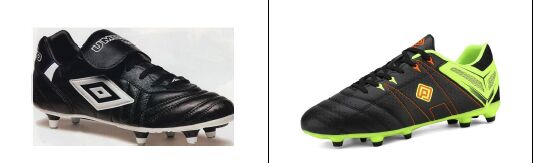
Umbro Boots and Dream Pairs Boots side by side.
What the High Court said
At trial, the High Court (Miles J) dismissed the claim. He said:
-
The two logos were only faintly similar.
-
There was no likelihood of confusion.
-
The way the boots were sold (mostly online) meant it was pretty clear they weren’t UMBRO products.
Iconix appealed.
The Court of Appeal disagreed
The Court of Appeal took a different view and reversed the decision. Their reasoning was that the trial judge focused too much on side-by-side image comparisons rather than how the logo appears in real life – particularly after sale. For example, when the boots are being worn on the pitch and seen from above.
In the Court of Appeal’s eyes, that “post-sale context” made all the difference. They found:
-
The logos were moderately similar when seen on boots.
-
There was a real likelihood of confusion.
-
Iconix should win.
Dream Pairs appealed to the Supreme Court.
What the Supreme Court actually decided
This is where it gets interesting.
The Supreme Court agreed with the Court of Appeal’s legal reasoning. Specifically, the Court said:
-
You can consider post-sale confusion – confusion doesn’t have to happen at the moment someone buys the product. If someone sees a boot on the pitch and thinks it’s an UMBRO product, that matters.
-
You can also assess similarity based on how the logos appear in the real world, not just on paper or screen.
So on the law, Iconix were right.
But – and it’s a big but – the Court then said: even though the Court of Appeal got the law right, they had no business overturning the original trial judge’s decision.
Why? Because:
-
The High Court judge had understood the law correctly.
-
He applied the multi-factorial test properly.
-
His conclusion wasn’t irrational or obviously wrong.
So despite agreeing with the legal arguments, the Supreme Court restored the original ruling in favour of Dream Pairs.
What is post-sale confusion?
Post-sale confusion is when someone who sees a product after it has been purchased wrongly assumes it comes from a different brand.
Think of someone spotting a pair of football boots on a pitch with a logo that looks like UMBRO’s. They might think the boots are UMBRO, even though the buyer knew they weren’t when they ordered them online.
This matters because trade marks are about more than just protecting the sale – they protect the brand’s identity and reputation. If people see a cheaper product and assume it’s from a premium brand, it can dilute that brand’s image, even if no one was confused at the checkout.
So trade mark law recognises that confusion after the point of sale – among fans, customers, or the wider public – can still damage a brand. That’s what the Court of Appeal found in this case, and what the Supreme Court confirmed as a correct interpretation of the law.
The practical takeaways for business owners
This case is a great example of how even if the law is on your side, you can still lose – because of how judges assess the facts.
Here are the key points for businesses to take away:
-
Trade marks are not just about what things look like on paper
Courts will assess how your brand appears in the real world – including how logos are seen when worn, used, or experienced post-sale.
-
Post-sale confusion can lead to infringement
It’s not just about the buyer being confused. If people in the public are misled after a product is sold, that can be enough to infringe a trade mark.
-
Trial judges get a lot of leeway
Even if an appellate court disagrees with a decision, they can’t overturn it unless it was plainly wrong. That means it’s crucial to get your evidence and arguments right first time.
-
Think commercially about enforcement
Brand owners like Iconix may still want to pursue infringers – but should factor in that victory isn’t guaranteed even when the law seems to be on their side.
If you need advice on trade mark disputes or trade mark registration, get in touch.