
This article was last updated 0 months ago and may not represent current law.
A sports lawyer's look at the prize money, the non-resident tax trap, and the contracts that decide who actually gets paid.
This is commentary on how the law works, not tax or legal advice. The figures are illustrations, not calculations of any individual's affairs, and anyone with a real question about their own position should take advice from a qualified tax adviser.
On Saturday, Linda Nosková beat her compatriot Karolína Muchová 6-2, 5-7, 6-3 on Centre Court to win the Ladies' Singles. At 21 she is the youngest Wimbledon champion since Petra Kvitová in 2011, and the winner of the first all-Czech Grand Slam final of the Open Era. She collected the Venus Rosewater Dish and a cheque for £3.6 million. As I'm publishing this, Zverev has just taken the first set against Sinner in the Gentlemen's Final.
Within hours of Noskova's win, a post was doing the rounds claiming that, by the time she leaves London, she will keep barely a third of it. The "brutal breakdown" ran through a 45% tax rate, worldwide endorsement income, and team and agent costs, and landed on a take-home figure of around £1.3 million.
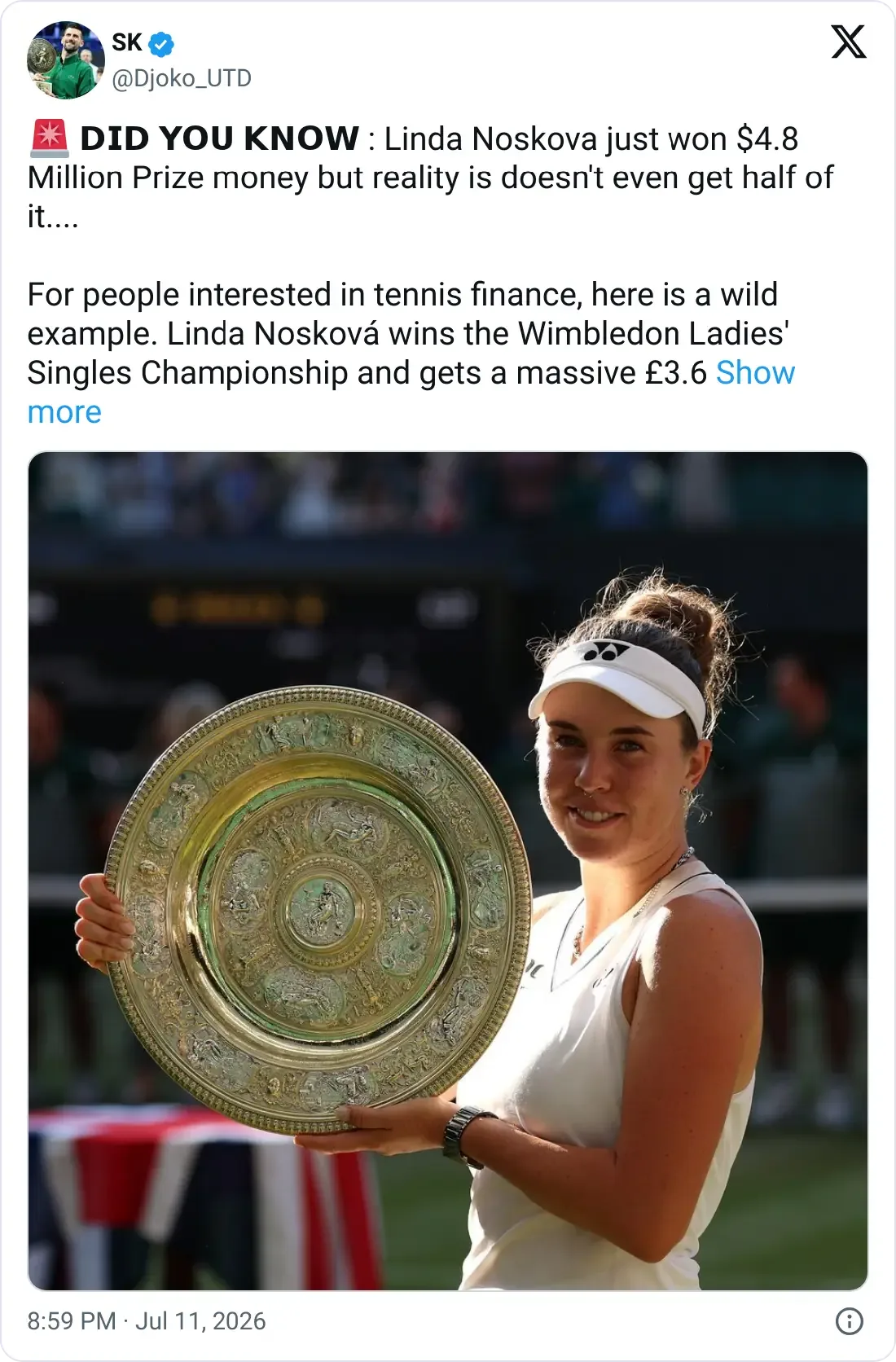
I have my sports lawyer hat on for this one and so I looked at it properly. The post has the right instinct, and it lands emotionally. It is also a little loose on the numbers and wrong on the mechanism in a couple of places that matter. So I thought, let's write about what English law actually does to that £3.6 million, why the prize money is the least of it, and the contract points that, in my view, decide who really ends up out of pocket. Some of this is settled law. Some of it is my reading of how these things tend to work, and I will flag which is which as I go.
What is actually on the cheque
Let's start with the actual figures. The 2026 total prize fund at Wimbledon is £64.2 million, a record and a 20% jump on last year. The singles champions each receive £3.6 million. Wimbledon has paid the men's and women's singles champions the same since 2007. Prize money is not cumulative: a player banks the amount for the round they reach, not the sum of every round along the way. First-round losers in the singles this year get £80,000.
So Nosková's headline number is right. £3.6 million is the gross. The question is what happens between the gross and the bank.
The withholding at source: 20%, not 45%
The first thing that happens is that the All England Lawn Tennis Club does not hand over £3.6 million. It cannot. As the payer, it is required to deduct tax before the money leaves.
This is the visiting performers regime, and it is the part the tweet got half right. A non-UK resident sportsperson who performs in the UK is taxable here on income connected with that UK performance. The organisation paying them, here the AELTC, must deduct income tax at the basic rate, currently 20%, from the payment where the amounts for the year exceed the personal allowance. The rules are in the Income Tax Act 2007, sections 965 to 970, with the deemed UK trade sitting in the Income Tax (Trading and Other Income) Act 2005, sections 13 and 14. The withholding machinery itself dates back to the Income Tax (Entertainers and Sportsmen) Regulations 1987.
So the "45% right off the bat" line in the post is wrong. The deduction at source is 20%, not 45%. Where does the 45% come from? It is real, but it is a different thing. 45% is the additional rate of income tax, the top band that applies to income over £125,140. The withholding is only a payment on account. The final bill is settled later, through self-assessment, and for a champion banking millions the top slice of the UK-taxable income will indeed be taxed at 45% - and even then, it is on taxable profit (i.e after expenses). The post collapsed two separate stages, the 20% deducted now and the up-to-45% assessed later, into a single number. The distinction matters, because it changes what the champion has to do next.
The bit that actually stings: worldwide endorsement income
Here is where the UK does something most countries do not and which really can sting.
Most countries tax a visiting athlete only on the income directly connected to the local event: the prize money, an appearance fee, a bonus for winning that specific tournament. The UK goes further. HMRC also reaches into the athlete's worldwide endorsement and sponsorship income and taxes a slice of it, on the basis that some of the value of those global deals is earned through UK performances.
The apportionment is done by counting days. There are two methods. The Relevant Performance Days (RPD) method compares UK competition days to worldwide competition days. The Relevant Performance and Training Days (RPTD) method compares UK days to worldwide competition andtraining days, and because most athletes train far more days than they compete, and mostly abroad, the RPTD fraction is usually smaller and usually preferred. The athlete can choose the method each year [Link to HMRC]
Let's have a look at a worked illustration - all made up, of course.
Suppose a champion has £20 million of global endorsement income and, across the tax year, spends 10 of her 100 worldwide performance days competing in the UK. Under RPD, 10% of that £20 million, so £2 million, is dragged into the UK tax net and taxed here at up to 45%. Switch to RPTD, add a few hundred training days almost all spent abroad, and the fraction shrinks. That is why the choice of method can be worth a fortune. Don't forget that for these, the income is usually offset by expenses so it's not straight on the full turnover/income figure.
Sure, the tax on the prize that hurts but it is the tax on a chunk of everything else the athlete earns from being famous, worked out by reference to a fortnight at SW19 that really stings.
It is also why this has always been more than an accounting footnote. The apportionment of global endorsement income is, to my mind, a large part of why a string of the world's best have limited their UK appearances over the years. Usain Bolt was open about racing here less than he would have liked because the UK tax exposure could dwarf an appearance fee. Roger Federer and Rafael Nadal habitually played their pre-Wimbledon grass warm-ups outside the UK. I cannot see inside their tax planning, but the pattern is hard to explain any other way. The rule does more than tax the athletes. It changes where they are willing to compete at all.
The case that gives it teeth: Agassi v Robinson
If you are wondering why athletes cannot simply route their endorsement deals through an offshore company and step outside all this, the answer has a name: Agassi v Robinson (Inspector of Taxes)[2006] UKHL 23.
Andre Agassi's endorsement contracts with Nike and Head were held not by him personally but by a company incorporated outside the UK, and the companies paying under those contracts had no UK trading presence either. The argument was that the UK withholding regime could not bite on a payment from one non-UK entity to another non-UK entity. The House of Lords disagreed. The scheme catches payments made to third parties, including image rights companies and personal service companies, where they are connected with the athlete's UK performance, regardless of whether the payer has any UK tax presence of its own. You can read the judgment on BAILII.
Agassi is the case that gives the regime its reach. It is the reason the offshore structure that works everywhere else does not provide a UK escape hatch on the UK-apportioned slice.
Personal versus corporate: two income streams, two regimes
A top player is not one taxpayer receiving one payment. In practice there are usually two quite different streams, taxed in two different ways.
Prize money is almost always paid personally. The AELTC pays the player. It falls squarely inside the visiting performers withholding, 20% is deducted at source, and the player then self-assesses as an individual on the deemed UK trade, with income tax at 20%, 40% and 45% on the balance after allowable expenses. This is personal income tax, on the individual's own return.
Endorsement and sponsorship income tends to be held in a corporate entity. My understanding is that most top players hold their commercial deals through an image rights company or a personal service company, often incorporated outside the UK, for reasons that have little to do with the UK and everything to do with how global sponsorship is structured and taxed at home. The instinct is that putting the money in a company takes it beyond the UK's reach. After Agassi, it does not. The apportioned UK slice of that worldwide endorsement income is still caught. What changes is not whether it is taxed but which regime taxes it and on whom: the charge attaches to the corporate structure rather than dropping straight onto the individual's personal self-assessment, with the corporation tax provisions in section 1309 of the Corporation Tax Act 2009 sitting alongside the income tax rules.
Three practical consequences fall out of this split.
First, the champion is running two tax analyses off one fortnight, not one. The prize money is a personal question. The endorsement apportionment is a corporate-entity question. Different rates, different returns, different filing obligations, often different advisers in different countries. All these expenses are claimable, but of course reduce the money in the pocket.
Second, the corporate wrapper is not the escape hatch people assume. It is a sensible and normal way to hold commercial income globally, but on the UK-apportioned portion it changes the plumbing, not the result. The tax is still due.
Third, the structure drives the drafting. Which brings me to the contracts, and to where this stops being an accountant's job and becomes a lawyer's.
The contracts that decide who is actually out of pocket
A tennis champion's fortnight sits on a stack of contracts. Each one carries a tax point, and those are where the money is potentially won or lost.
A caveat before I go on. I have not acted on ATP or WTA tour contracts, and I have never seen a top player's endorsement or agency papers. So some of what follows is informed guesswork rather than first-hand knowledge. But I have drafted and negotiated enough commercial and image rights agreements in other settings to have a fair idea of how these are likely to be built, and where the tax pressure points tend to sit. Read the next few paragraphs as a working theory of how a champion's paperwork probably hangs together, not as a description of anyone's actual deals.
Endorsement and image rights agreements. The clause I would expect to matter most is the tax gross-up. When a UK payer, or a payer connected to a UK performance, has to withhold tax before paying an image rights company, who bears that withholding? If the contract says the payment is made net of any required withholding, the athlete's company absorbs it. If it says the brand must gross up so that the company receives the agreed sum free of withholding, the brand carries it. On a large endorsement deal I would expect those clauses to move serious sums, and to be negotiated line by line rather than lifted from a template. Payments in kind - a car, a watch, equipment - are caught too, and would need grossing up to a cash-equivalent value for the withholding calculation, which is an easy trap to fall into.
Agent and management agreements. The post mentioned agents taking 15% to 20%, and that broad range looks right for the market. The clause I would watch is the base the commission is calculated on. Commission on gross earnings and commission on net earnings are very different numbers once UK tax and expenses are in the picture, and a champion who has just had a chunk of endorsement income apportioned to the UK and taxed at up to 45% would feel the difference sharply if the agent's percentage sat on the gross. Whether apportioned UK business expenses, including a proportion of that agent's fee, can be set against the UK-taxable income is part of the same sum.
Appearance fees and win bonuses. Sponsors often pay a bonus for winning a specific tournament, or an appearance fee for playing it. A bonus tied specifically to a UK event is not apportioned, it is fully UK income and fully UK-taxable. Drafting that ties a bonus to a UK result rather than framing it as part of a global retainer pulls the whole payment into the UK net. How these clauses are written changes the tax outcome.
The prize money terms themselves. Entry to the Championships carries its own conditions: the code of conduct, the commitment to play, the terms on which prize money is paid. These are less negotiable, the player takes them or does not enter, but they set the baseline against which everything else is structured.
The point, as I see it, is simple. Tax does not just land on the athlete after the contracts are signed. The contracts decide who carries the risk. Get the gross-up and the commission base right and the champion should keep a good deal more. Get them wrong and the "brutal breakdown" starts to look optimistic.
Not unique, and not inescapable, but brutal for some
Two corrections to the "cannot escape the UK tax net" framing.
First, the UK is not doing something no one else does. The right of the country where a sportsperson performs to tax that performance is baked into Article 17 of the OECD Model Tax Convention, the template on which most of the world's double tax treaties are built. What is comparatively aggressive about the UK is the apportionment of global endorsement income, not the taxing of the UK performance itself.
Second, for most athletes the UK tax is not simply lost. Under the relevant double tax treaty, the athlete's home country will usually give a credit for the UK tax paid, so it is offset against the home-country bill rather than paid twice. The system is a cash-flow and complexity problem for them, not a straight doubling of tax.
The people for whom it genuinely bites are those resident in low-tax or no-tax jurisdictions, because they have little or no home-country liability to credit the UK tax against. The credit is worthless if there is nothing at home to set it against.
Today's Gentlemen's Singles final makes the point nicely. At the time of writing the final is being played this afternoon, Jannik Sinner against Alexander Zverev. Both finalists are, on the public record, resident in Monaco, which levies no personal income tax. Zverev is German by nationality but, like Sinner, is widely reported to be based in the Principality. Whichever of them lifts the trophy, he will be squarely in the category where the UK apportionment stings hardest and the foreign tax credit does least, because there is no Monaco income tax bill waiting at home to absorb it.
Contrast Nosková. She is based in the Czech Republic, a normal-tax jurisdiction. Her UK tax on the prize and on any apportioned endorsement income should, under the UK-Czech treaty, be largely creditable against her Czech liability. Same tournament, same trophy, materially different tax reality, decided by where each of them lives.
The escape hatch that exists, and why Wimbledon does not use it
There is one route out of all this, and it tells you something about how sport gets hosted.
The government has a power, in section 48 of the Finance Act 2014, to grant exemptions from this tax for major sporting events by regulations. Before that, exemptions were given one event at a time in the Finance Acts themselves, which is how it was done for the London 2012 Olympics and Paralympics, the 2013 Champions League final and the Glasgow 2014 Commonwealth Games. Non-resident competitors at those events were relieved of the UK charge on their performances.
The reason the power exists is precisely the Bolt problem. If the tax deters the best athletes from turning up, the country loses the event, and the tourism, broadcast and economic value that come with it. An exemption is the price of hosting.
Wimbledon does not get one, and never has. It does not need to. Unlike a one-off event bidding against other host nations, Wimbledon is the destination. The best players in the world will come and play it whatever the tax treatment, because it is Wimbledon. The exemption power is leverage for events that have to compete to be hosted. Wimbledon has no such problem, so the champions pay.
So what does she actually keep?
So, back to the tweet. Its instinct was sound. The champion does keep far less than £3.6 million, and the reasons are real. It is just more precise than "45% and then some."
The prize money is taxed, first by 20% withheld on payment and then trued up to as much as 45% on the top slice but with reasonable expenses deducted to arrive at a profit figure. On top of that is the apportioned slice of worldwide endorsement income, which can in theory produce a UK charge bigger than the tax on the prize itself, and which no offshore company removes after Agassi. Add agent commission and the cost of a travelling team, and the gap between the headline and the bank balance is wide.
The size of that gap is not set by a tax table. It turns on where the player lives, on the choice between RPD and RPTD, on treaty relief, and most of all on the contracts: who bears the withholding, what the commission sits on, how the bonuses are framed. Two champions can hold the same trophy and walk away with very different net figures. The difference is drafting and where they live, not the rates.
And that, for me, is the sports lawyer's point. The tax is real and it is heavy. But it is not a flat toll on a cheque. It gets allocated, and allocation is a matter of negotiation. My hunch is that the champion who keeps the most is not usually the one who won the most prize money. It is the one whose contracts were drafted by someone who saw all of this coming.
Written by Steven Mather, a business solicitor acting on company sales and purchases. This is general information about the law, not legal advice on your situation. Law correct as at .