Trade Marks vs. Copyright: Which one is right for you?
Copyrights and trademarks are both important tools in protecting your intellectual property, but knowing what you need can be confusing. Find out more here.
Read it
Commercial
Who owns your logo, code and content, how to license or assign it, and when to register a trade mark. Commercial IP advice for businesses on fixed fees.
A lot of businesses don’t own as much of their intellectual property as they think they do. The logo was drawn by a freelancer, the website was built by an agency, the software was written by a contractor who has since moved on, and nobody signed anything saying the company owns the result. That usually comes to light when someone wants to buy the business, or when you fall out with the freelancer.
I advise businesses across England and Wales on the commercial side of intellectual property, which means who owns it, how to license it, how to transfer it and how to register a trade mark. I’m an expert in intellectual property law and have done a lot of this work, and there aren’t many solicitors in Leicester who can say that.
There are four main rights, which are copyright, trade marks, design rights and patents. Copyright covers things that are written, drawn, photographed, recorded or coded, and it arises automatically, so there’s no register in the UK and the online “copyright registration” services are a waste of money. Trade marks protect the names and logos you trade under, and they’re worth registering. Design rights protect the look of a product, with some protection arising automatically and stronger protection available if you register the design at the Intellectual Property Office. Patents protect inventions, and for those you’ll need a patent attorney as I don’t deal with them.
I’ve written a longer piece on trade marks and copyright and which one you need, and another on where intellectual property law runs out when someone copies your product.
Paying someone to create something for your business doesn’t by itself make you the owner of it, and this is where a lot of business owners go wrong. Under section 11 of the Copyright, Designs and Patents Act 1988 the first owner of copyright is the author. The exception is work made by an employee in the course of their employment, which belongs to the employer unless they’ve agreed otherwise. A freelancer, a design agency, a software developer or a director working through their own company is not your employee, so the copyright in what they produce starts with them even though you’ve paid for it.
To move it across to you there needs to be an assignment, and under section 90 an assignment of copyright only works if it’s in writing and signed by or on behalf of the person giving it up. An email from the right person saying “it’s all yours” might be enough, but an invoice marked as paid will not be.
This is easy to deal with if you do it early, by putting an ownership clause in the contract with anyone who creates something for you before they start. Where the work has already been done, you should get a short assignment signed while relations are good. For software, the type of development contract matters a lot, and I’ve written about the three main types.
A licence lets someone else use what you own without you giving it away. The main things a licence needs to deal with are what exactly is licensed, whether it’s exclusive, where and for how long, what the other side pays and how that’s checked, who owns any improvements, what quality standards apply to your brand, and what happens to stock, customers and materials when it ends. I draft and review licences for brands, software, content and know-how, and I can act for either side.
The other side of this is using someone else’s material without a licence, which can turn out to be expensive, as my note on a £134,666 copyright bill for social media posts shows.
On a sale, the buyer’s solicitor will ask who owns the name, the domain, the website, the software and the customer data, and will want to see the paperwork. Gaps in that paperwork come up often in due diligence, and although they rarely stop a deal they give a buyer a reason to ask for an indemnity or to hold money back, and the person whose signature is missing may by then know that a sale depends on it.
On an asset sale the intellectual property has to be transferred by assignment, and registered trade marks then need the change of owner recorded at the IPO. On a share sale the company keeps what it owns, so the question is whether it owned it in the first place, and quite often the trade mark turns out to be registered in the founder’s own name. If you’re planning to sell in the next few years, it’s worth sorting this out as part of exit planning.
Registering a trade mark is one of the least expensive ways for a small business to protect its brand, and it’s a large part of my IP work. I search the register, advise on classes and file the application for a fixed fee. The process, the timescale and the cost are all on my trade mark registration page.
I can also help with a registered design application where it’s the look of a product that needs protecting.
I don’t run infringement claims or other contentious intellectual property work, which is picked up by Abby Minns, a fellow consultant solicitor at Nexa Law. If your problem is someone copying you, or you’ve had a letter accusing you of copying them, I’ll introduce you to Abby, and she will run the matter and quote her own fee. There’s more on the intellectual property disputes page and about the people I refer to on my Nexa colleagues page. All of my own work is carried out through Nexa Law Limited, which is authorised and regulated by the Solicitors Regulation Authority.
I work on fixed fees with a written scope of work, agreed before I start. Trade mark registration has a set price, which is on its own page. Licences, assignments and other documents depend on what’s involved, so I quote once I’ve seen the details. As a guide, a short assignment is a small job, whereas a licence with royalties and territories is a bigger one.
If you’d like to know where you stand, send me the details and let me know what the IP is, who created it and what you want to do with it.
Also in this section
Related writing
Copyrights and trademarks are both important tools in protecting your intellectual property, but knowing what you need can be confusing. Find out more here.
Read it
A car event organiser paid £134,666 for reposting magazine photographs on Facebook and Instagram. What Tipping v Smith teaches small business owners about image copyright.
Read it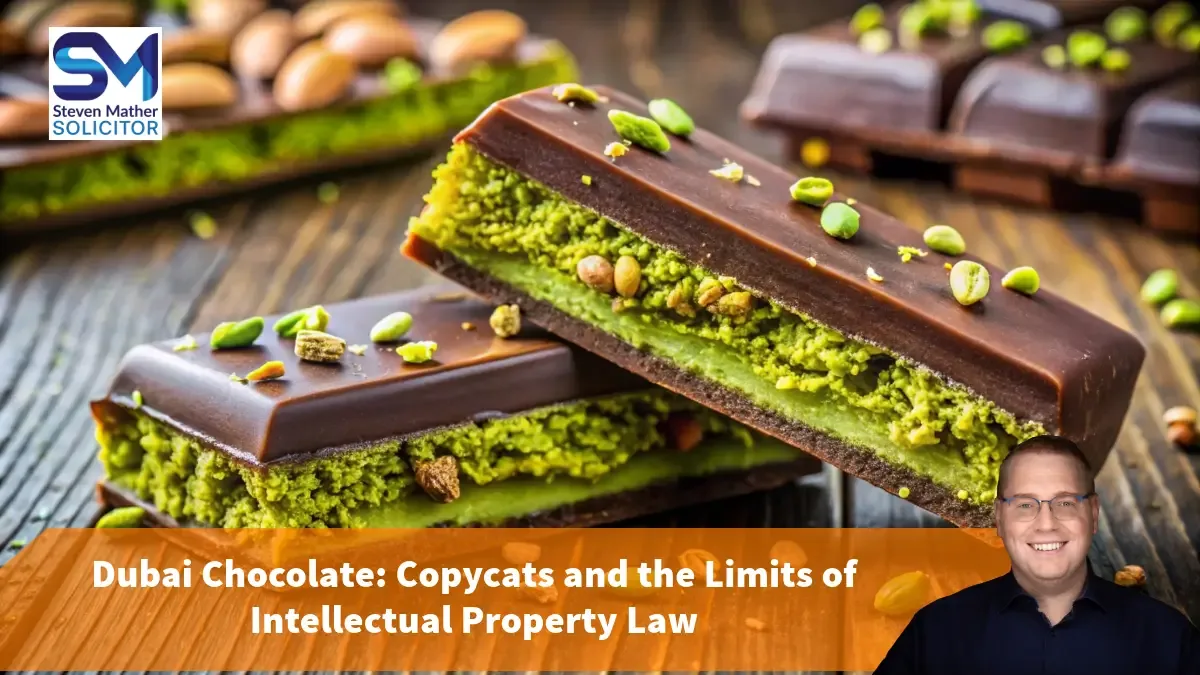
The viral rise of “Dubai chocolate” - more formally known as the “Can’t Get Knafeh of It” bar from Fix Dessert Chocolatier - has been a social media…
Read itSwipe for more
Drop me a line
I’ll give you a steer and tell you whether I’m the right person for the job. If I’m not, I’ll say so and point you at someone who is.
StevenAI answers from this website. It gives general information rather than legal advice on your situation, and using it does not make me your solicitor.