I've drafted my terms and conditions with AI. Can you just check them?
I've had a version of this enquiry four times in the last fortnight or so. A new business has used ChatGPT (or Claude, or Gemini) to draft its terms and…
Read it
Commercial
Terms and conditions written around how your business actually quotes, delivers and gets paid, for B2B, consumer or online sales. Fixed fee agreed upfront.
Fixed fee from £750 plus VAT, agreed in writing before I start.
Your terms and conditions are the contract you use every time you sell something. A one-off commercial contract is negotiated for a particular deal, whereas standard terms are written once and applied to every customer, so a mistake in them is repeated on every order. I draft terms and conditions for businesses in England and Wales which sell to other businesses, to consumers, or both, including online.
What’s important is that your terms and conditions work exactly how your business works. Do you quote, then take an order, and then deliver? Or do you just deliver on request from a price list? Or perhaps you have a website which takes payment upfront, or you sell a subscription? Many problems come from terms which describe a process the business doesn’t actually follow, as that makes it very hard to show that a customer ever agreed to them.
Most terms cover the same ground. They set out what you’re supplying and to what standard, the price, when it’s payable and what happens if it isn’t paid (interest, suspension, and keeping ownership of goods until you’ve been paid). They deal with delivery and when risk passes, what the customer has to do, and what happens when something is wrong with the goods or the service. They also cover how far your liability goes, how either side can end the contract, data protection, intellectual property and the governing law.
It’s just as important to make sure that the terms apply in the first place. Terms which first appear on the back of an invoice arrive after the contract has been made, and they generally won’t bind anyone, so they need to be in front of the customer before the order is accepted. Unusual or harsh clauses also need to be pointed out specifically, and I’ve written about why onerous terms buried in the small print are unlikely to be enforceable.
Selling to businesses and selling to consumers are different enough that one document for both rarely works.
Between businesses you have a lot of freedom, so you can cap your liability, exclude certain kinds of loss and shorten the time for bringing a claim. The main limit is that, in standard terms, exclusions and limitations have to be reasonable under the Unfair Contract Terms Act 1977, and a cap which is set very low may well fail that test. There’s more in my article on essential terms when selling to businesses.
With consumers the law gives the customer much more protection. The Consumer Rights Act 2015 gives customers rights on quality, fitness for purpose and services being performed with reasonable care, and you can’t contract out of those. A term which is unfair doesn’t bind the consumer, and consumer terms have to be written in plain language. Since April 2025 the Competition and Markets Authority has been able to enforce consumer law directly and fine businesses itself, so it’s no longer only a question of whether a clause would stand up in court. I’ve covered the CMA’s 2026 unfair contract terms guidance separately, along with a general guide to selling to consumers.
I’ve run websites of my own since about 1998, so I’ve been there and done that with online businesses myself. Trading online is not much different from trading in the real world, although there are a few extra requirements.
If you sell to consumers at a distance, the Consumer Contracts Regulations 2013 require you to give certain information before the order is placed, and in most cases to give the customer 14 days to cancel. There are exceptions (personalised goods and some digital content, for instance), and what you have to refund and when is set out in some detail. If the information isn’t given properly, the cancellation period can be extended, which can be expensive if it affects a lot of orders.
An online business usually needs a few documents besides its terms of sale. Website terms of use deal with what visitors can do with the site and its content, and a privacy notice explains what personal data you collect and why, as the UK GDPR and the Data Protection Act 2018 require. If the site uses cookies which aren’t strictly necessary, you also need a cookie notice and a proper consent mechanism, and apps and software need licence terms (an EULA) as well. I’ve drafted all of these many times, including terms for marketplace and app-based businesses where there are three parties to think about, which are the platform, the supplier and the customer.
For a simple privacy notice you may not need me, as the ICO has a free privacy notice generator which will do the job for a straightforward business (I’ve written a short piece about it). Please don’t copy another site’s terms, though, as that could lead to a claim for copyright infringement, and you would also be relying on drafting which was written for someone else’s business and often for another country’s law.
If you want to use a template you’ve downloaded online, go for it, provided the business is simple and the risk is low, as a template is better than nothing. The risks are that it wasn’t written for the way you trade, that it’s American (they often are), and that you won’t know which parts matter until a customer relies on one of them.
More and more people now come to me with terms they’ve drafted using AI and ask me just to check them. I’m happy to do that, and a review of existing terms is £750 plus VAT, for which you get a written report on what’s wrong and what I’d change. That doesn’t include marking up or redrafting the terms, which I can quote for separately. AI-drafted terms tend to read well and look complete, but they often turn out to mix consumer and business provisions, cite the wrong country’s law, or describe an ordering process which isn’t yours. Quite often my advice after a review is that it would be quicker and cheaper to redraft from scratch than to repair what’s there, and if I can see that from a first read, I’ll tell you before you’ve paid for the review. I’ve written more about this in I’ve drafted my terms and conditions with AI. Can you just check them?
Drafting is a fixed fee, agreed in writing before I start. A set of terms and conditions ranges from £750 plus VAT for something short and simple to around £3,500 plus VAT for a business with several sales channels, consumer and business customers or a full set of website documents. I’ll quote once I understand how you sell.
To quote, I need to know what you sell, who to, how orders are placed and paid for, and what has gone wrong in the past, as that usually shows what the terms most need to deal with.
If you’d like me to draft or review your terms, send me the details, with your current terms if you have any, and I’ll come back to you with a fixed fee and a view on whether they need a review or a rewrite.
Also in this section
Related writing
I've had a version of this enquiry four times in the last fortnight or so. A new business has used ChatGPT (or Claude, or Gemini) to draft its terms and…
Read it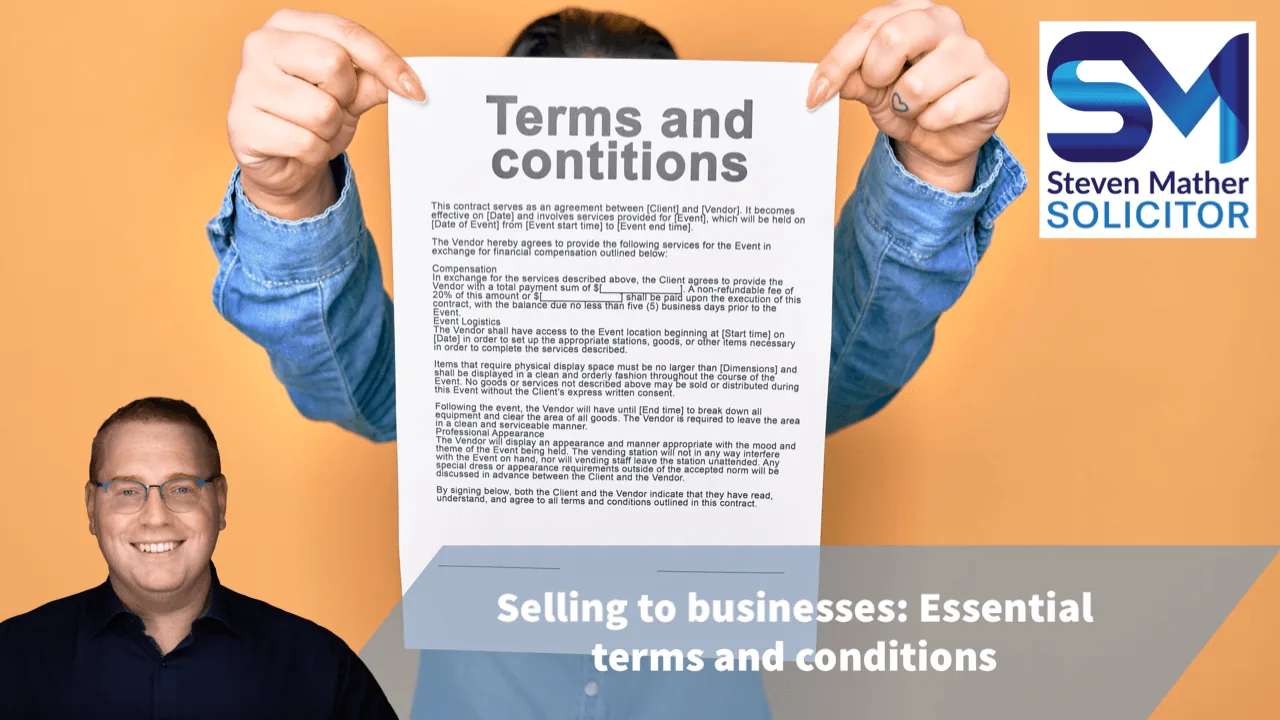
Crafting clear terms and conditions is crucial for any business. Discover what to include in this comprehensive guide.
Read it
Selling to consumers (DTC or D2C) involves legal considerations & compliance essentials. Read this guide to discover the scoop.
Read itSwipe for more
Drop me a line
I’ll give you a steer and tell you whether I’m the right person for the job. If I’m not, I’ll say so and point you at someone who is.
StevenAI answers from this website. It gives general information rather than legal advice on your situation, and using it does not make me your solicitor.