What processes are possible for debt recovery?
In this article, discover how to help your business to recover money you're owed. Get a solution that will handle the situation quickly and effectively to manage cashflow.
Read it
Disputes
A customer won't pay? Letters of claim, statutory interest, court claims and enforcement, handled by Nexa colleagues who recover business debts every day.
For any business, cash is king. Where a customer owes you money and has stopped answering, you can carry on pressing for payment yourself or you can instruct a solicitor to recover the debt for you. The usual route is a solicitor’s letter of claim, then a court claim and then enforcement, and a debt that isn’t disputed can move through those stages fairly quickly.
I don’t do debt recovery work myself. At Nexa Law it’s dealt with by my colleagues Connor Dolan and Ailsa Fairchild, who recover debts for businesses day in, day out. If you send me the details I’ll make the introduction, and they’ll act for you and quote their own fee. I’m based in Leicester, but the work is done for businesses anywhere in England and Wales. You can read about how I work with Nexa colleagues.
The first step is a formal letter of claim. A solicitor’s letter gets a good number of invoices paid, as it shows the debtor that you’re prepared to go further.
How long you must give the debtor depends on who they are. If the debtor is an individual, which includes a sole trader, the Pre-Action Protocol for Debt Claims applies. The letter has to enclose the protocol’s information sheet, reply form and a financial statement form, and you can’t start court proceedings until 30 days after the date of the letter. If they reply or ask for documents, further 30-day periods apply. A letter giving a sole trader seven days to pay therefore doesn’t comply, and a court can penalise you in costs for it.
The protocol doesn’t apply to debts between businesses unless the debtor is a sole trader. For a limited company or LLP the general Practice Direction on pre-action conduct applies, which asks for a reasonable time to respond, and 14 days is its example for a straightforward case.
On business-to-business debts, the Late Payment of Commercial Debts (Interest) Act 1998 lets you charge statutory interest at 8% above the Bank of England base rate, unless your contract sets a different rate. You can also claim a fixed sum for each late payment, which is £40 on a debt under £1,000, £70 from £1,000 up to £9,999.99, and £100 for £10,000 or more. On an old invoice the interest can add up to a worthwhile amount, and the fact that it keeps running gives the debtor a reason to pay sooner.
A court claim is issued, usually online. The debtor then has a limited time to pay, admit the debt or file a defence, and if they do nothing you can ask for judgment in default without a hearing.
If the debtor defends the claim, it stops being debt recovery and becomes a contract dispute, with a different timescale and cost. Claims of up to £10,000 normally go to the small claims track, where you generally can’t recover your solicitor’s costs from the other side even if you win. For smaller debts that often means it makes more sense to run the claim yourself, and my small claims guide explains how.
Getting a county court judgment doesn’t mean that you’ve been paid, and if it goes unpaid it has to be enforced. The options include enforcement agents (bailiffs or High Court enforcement officers) taking control of goods, an order requiring a bank or other third party holding the debtor’s money to pay it to you, a charging order over property, or an attachment of earnings order against an individual. Which of those is worth trying depends on what the debtor has, so anything you know about their assets is useful.
For larger undisputed debts, a statutory demand followed by a winding-up or bankruptcy petition is sometimes an option, though the courts don’t like it being used to collect a debt that’s really in dispute. That’s covered on the insolvency page.
A lot of debts are harder to collect than they need to be because the paperwork is weak, with no signed terms, no agreed payment date and no right to interest or to recover costs. Decent terms and conditions deal with all of that, and drafting those is my own work.
Send me the details and I’ll pass them to Connor and Ailsa, who’ll tell you what they can do and what it will cost.
Also in this section
Related writing
In this article, discover how to help your business to recover money you're owed. Get a solution that will handle the situation quickly and effectively to manage cashflow.
Read it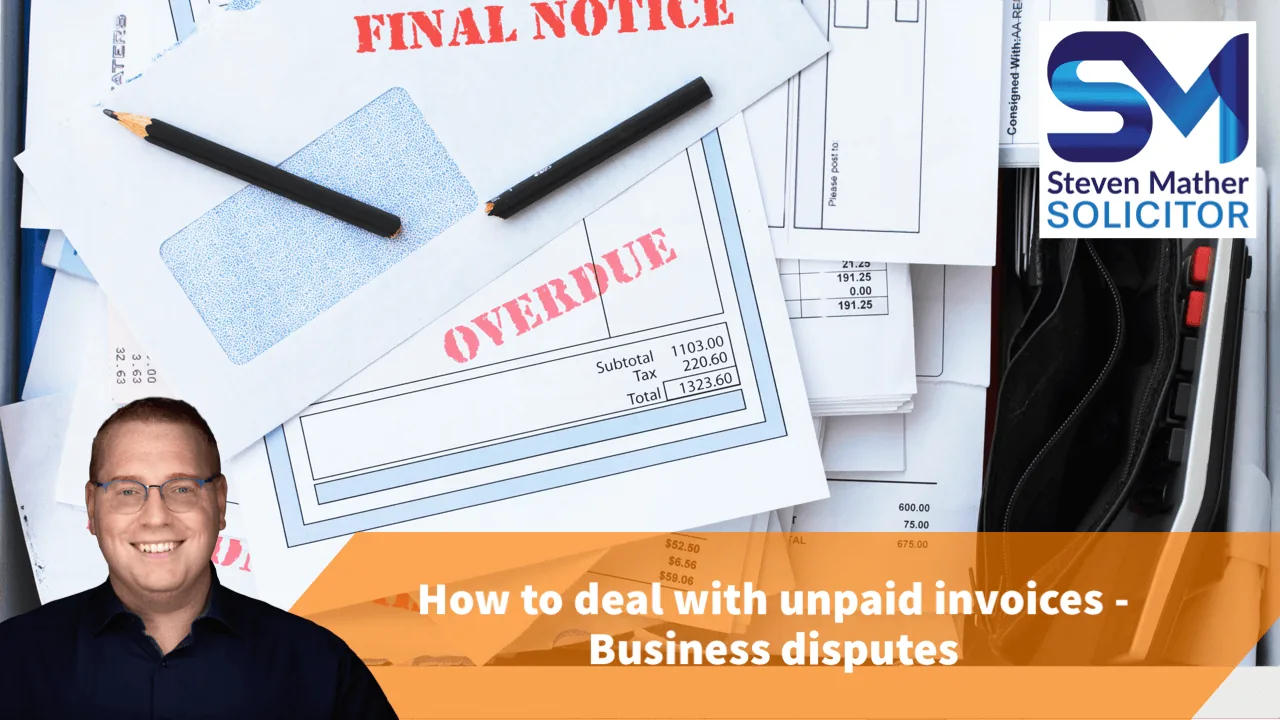
Unpaid invoices. The term is something all business owners have experienced at some point. But it doesn't make it less unsettling and frustrating. There…
Read itThe old adage says that “cash is king”, and in difficult economic times it’s never more true. Indeed, it is such an issue that there’s a Government…
Read itSwipe for more
Drop me a line
I’ll give you a steer and tell you whether I’m the right person for the job. If I’m not, I’ll say so and point you at someone who is.
StevenAI answers from this website. It gives general information rather than legal advice on your situation, and using it does not make me your solicitor.