Subcontracting ‘Back to Back’ Agreements - What’s a back to back agreement ?
Back to back agreements are a legal contract used in subcontracting - unsure if you need one? Read this article to learn about back to back contracts .
Read it
Disputes
Unpaid valuations, pay less notices, defects and adjudication. I don't run construction disputes; I match you with the right Nexa colleague for the job.
Building disputes tend to be about money that hasn’t been paid, work that isn’t right, or a job that has overrun and an argument about whose fault that is. This page explains how those arguments usually get resolved and what to do first.
I should say straight away that I don’t run construction disputes myself. Several of my colleagues at Nexa Law do, for contractors, sub-contractors, developers and property owners. If you send me the details I’ll review them and suggest the best person for it, taking into account what the dispute needs, who has capacity and how they price. That colleague then acts for you and quotes their own fee. You can read about how I work with Nexa colleagues.
Most commercial building disputes start with a payment, and construction contracts are regulated by Part II of the Housing Grants, Construction and Regeneration Act 1996, which is usually just called the Construction Act. The Act applies whether the contract is a JCT or NEC standard form, a one-off agreement or an exchange of emails, and it sets rules on how and when payment is to be made, including the notices each side must give.
Those notices cause a great many disputes. If the paying party wants to pay less than the sum applied for, it has to say so in a pay less notice, in time and in the right form. If it doesn’t, the sum applied for can become due whatever the true value of the work, and the argument about the true value has to be had afterwards, which means a main contractor can end up paying a sub-contractor more than the work was worth, at least for the time being. If you’ve applied for payment and heard nothing, or you’ve received an application you disagree with, then the dates are the most important thing and you shouldn’t wait.
Under section 108 of the Act, a party to a construction contract can refer a dispute to adjudication at any time. An independent adjudicator is appointed and has to decide within 28 days of the referral, unless the parties agree longer. The decision binds both sides unless and until a court or arbitrator decides otherwise, and the courts enforce adjudicators’ decisions promptly.
It’s quick and much cheaper than a trial, which is why most payment disputes in the industry are settled or decided this way. It does mean that if you receive a notice of adjudication the timetable is counted in days, so you need a solicitor who does this work regularly and you need them straight away.
Bigger or more technical arguments (defects, delay and loss and expense claims, final accounts) can still end up in court or arbitration, usually with expert evidence from a surveyor or engineer.
The Construction Act doesn’t apply to a contract with a residential occupier (section 106), so a homeowner arguing with a builder has no automatic right to adjudicate. In practice these disputes run as ordinary contract disputes, with consumer law on the homeowner’s side.
If you’ve got a dispute with your builder, here’s what I suggest. Speak to an RICS surveyor and get a written report on what’s defective, what’s unfinished and what it will cost to put right, as without one each side only has its own opinion. See whether your home insurance includes legal expenses cover. Then try to resolve the matter directly with the builder, because litigation is the last resort and the legal costs of a fully fought building dispute can soon come close to the value of the claim.
Where a home was badly built in the first place, the Building Safety Act 2022 lengthened the time limits for claims under the Defective Premises Act 1972 from 28 June 2022 (section 135). The rules are detailed, so take advice on your own dates rather than assuming you’re out of time.
A fair number of these disputes come from a sub-contract that doesn’t match the main contract, or from there being no written contract at all. That part is my own work, as I draft and review commercial contracts, and I’ve written about back to back sub-contracts and the problems caused by gaps between the two documents.
Send me the details and tell me about any deadline you’re up against, particularly an adjudication timetable. I’ll introduce you to the colleague best placed to take it on.
Also in this section
Related writing
Back to back agreements are a legal contract used in subcontracting - unsure if you need one? Read this article to learn about back to back contracts .
Read it
Legal Expenses Insurance, sometimes called Family Legal Protection, Legal Insurance, or Family Legal Expenses Insurance, is an insurance product that…
Read it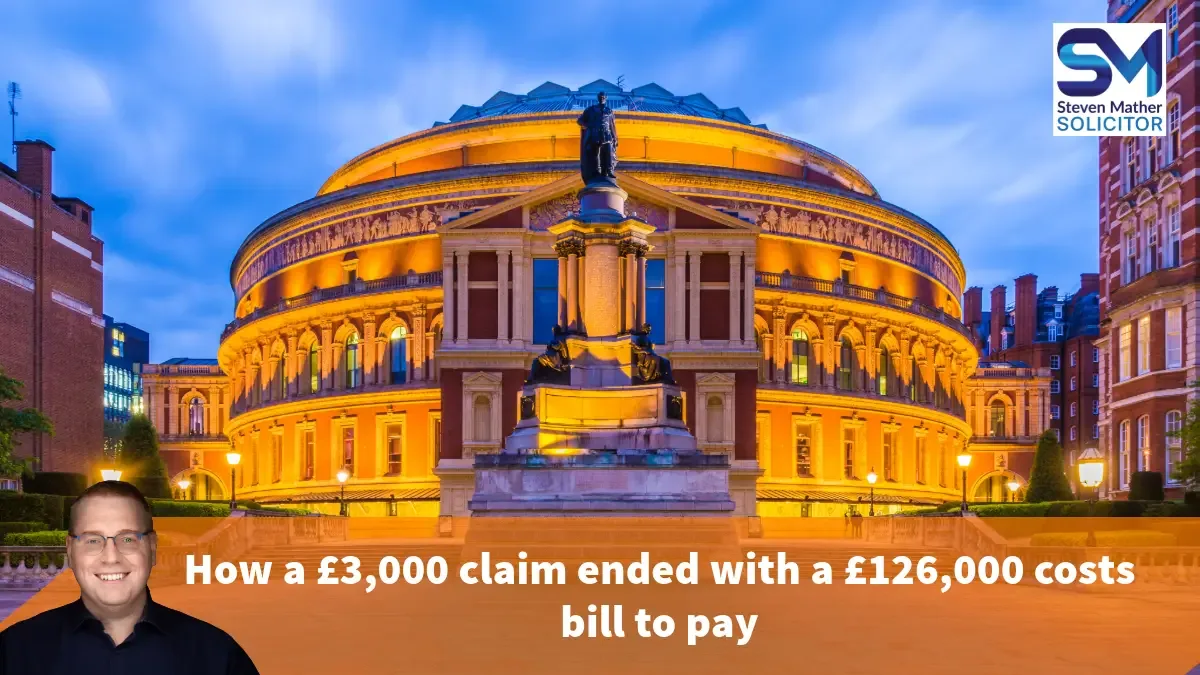
Issuing a “small claim” isn’t always risk free. A recent Royal Albert Hall case shows how a modest dispute can be pushed onto the fast track, leaving the losing party with a five-figure costs bill - and even facing indemnity costs where the court finds their conduct unreasonable.
Read itSwipe for more
Drop me a line
I’ll give you a steer and tell you whether I’m the right person for the job. If I’m not, I’ll say so and point you at someone who is.
StevenAI answers from this website. It gives general information rather than legal advice on your situation, and using it does not make me your solicitor.