
This article is now 0 months old and may not represent current law.
On 14 October 2026 the Competition and Markets Authority announced that it had fined Gold’s Gym (UK) Limited, a franchise running four gyms in London, £45,000 for not including its joining fee in the price of its memberships. The same announcement covered £4.8 million for Wayfair and £1.2 million for Appliances Direct (CMA press release), which is what made the headlines, but the gym is the case most owner-managed businesses should read. It shows that the CMA will use its new fining powers against a small business, and the mistake it made is one a lot of businesses could make without realising.
The CMA has published its final infringement notice, and the annex to it includes screenshots of the gym’s sign-up pages. They are worth looking at, because nothing on them looks dishonest. The joining fee is there on the page; it just isn’t in the price. A lot of businesses that take memberships, subscriptions, bookings or deposits set out their prices in much the same way.
What the website showed
The notice covers 6 April 2025 to 7 May 2026. Gold’s Gym sold annual memberships (paid upfront) and Direct Debit memberships online, and both carried a joining fee, £50 on an annual membership and £10 on a Direct Debit one.
On the old version of the site, someone choosing an annual membership saw the membership at £359.88. Once they picked it, a summary appeared showing the joining fee of £50 on one line and “Total Due Now” of £359.88 on the next.
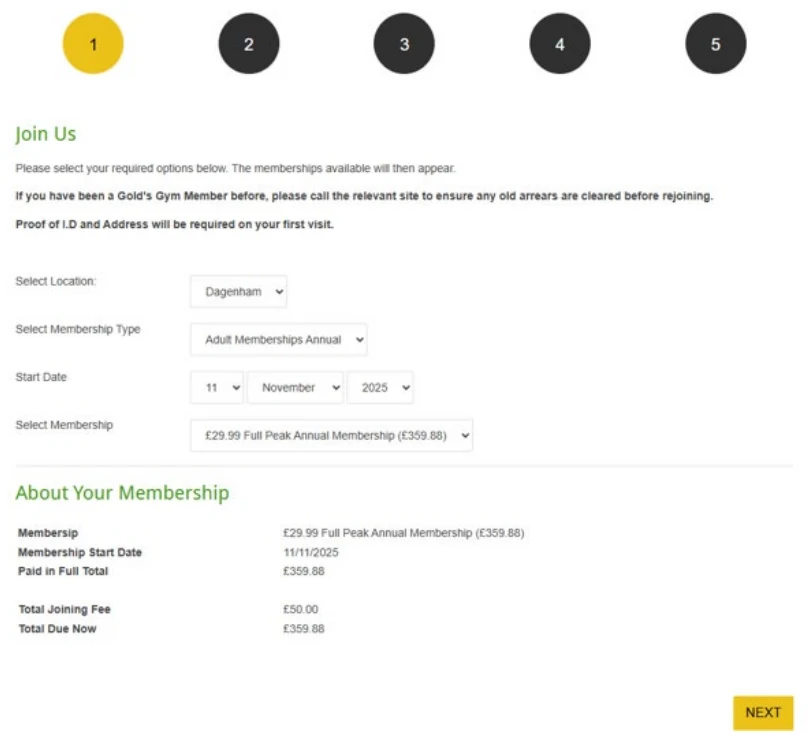
The real total, £409.88, didn’t appear until the payment page, after the customer had entered their personal details. The gym said that particular error came from its third-party booking system provider. That didn’t get it off the hook, which is worth knowing if you assume your booking software deals with this for you.
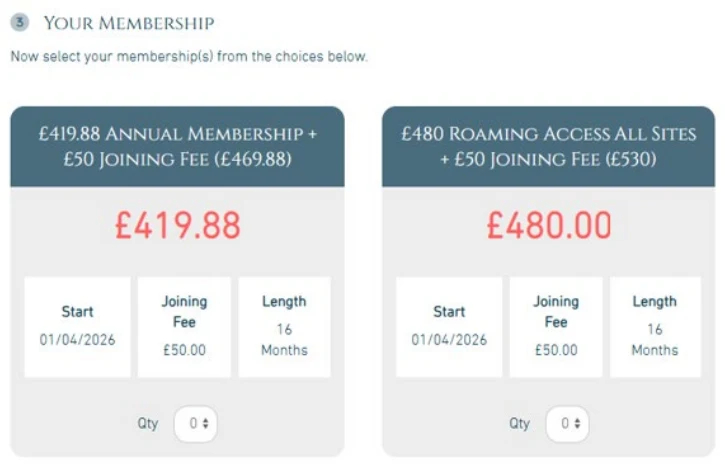
The site was rebuilt in January 2026 and the new version was better, but not good enough. The membership card showed £419.88 in large red figures, with “+ £50 joining fee (£469.88)” in the small print of the heading above it. The CMA’s view was that the total was disclosed but not prominently enough, so it was unclear or unlikely to be seen, which counts as leaving it out.
The Direct Debit memberships had the same problem in a different form. The cards showed a monthly price, with the £10 joining fee in a separate box and no total anywhere, either for the minimum term or for the first month.
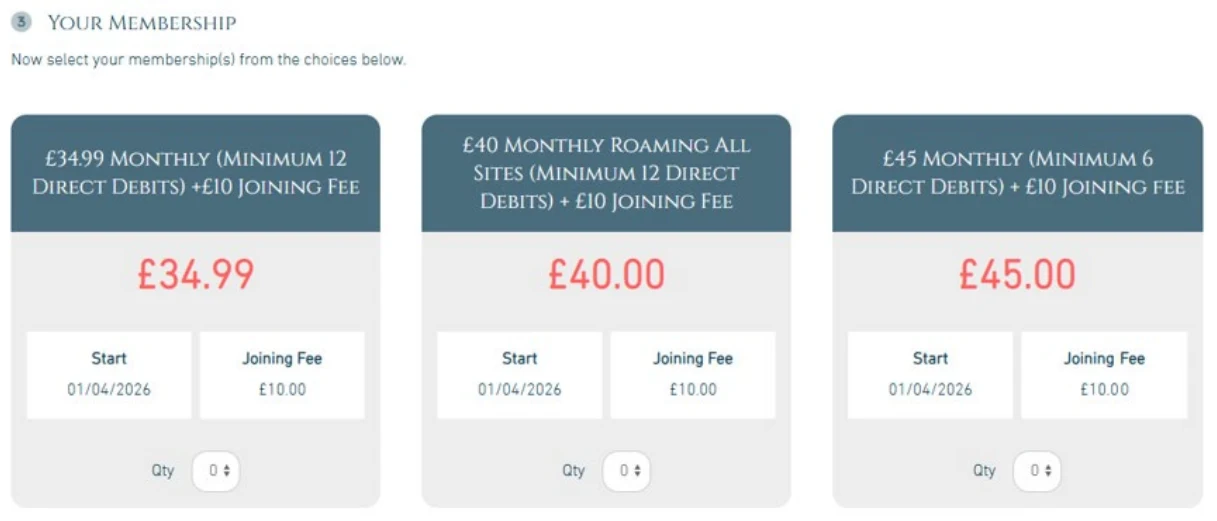
Screenshots from Annex A to the CMA’s final infringement notice of 29 September 2026. Contains public sector information licensed under the Open Government Licence v3.0.
The rule it broke
Section 230 of the Digital Markets, Competition and Consumers Act 2024 says that whenever you give a consumer enough information about a product and its price for them to decide whether to buy it (an “invitation to purchase”), you have to give them the total price, including every fee they will necessarily have to pay. It has to be given clearly, at the right time and in a way they are likely to see. Leaving it out is an unfair commercial practice under section 225.
Two points from the notice are easy to miss. The first is that every invitation to purchase has to comply, so getting the total right on the payment page doesn’t help if the homepage, the membership selector and the details page all show a lower figure. The second is that a separate box saying “Joining fee £10” next to a monthly price isn’t a total; the CMA calls that price partitioning and treats it the same way as adding the fee later on. For fixed-term contracts paid monthly, the CMA’s pricing transparency guidance allows either the total over the minimum term or a total monthly price with a prominent statement of how many months the customer is committed for. In the gym’s case the CMA directed it to use the first, as the simplest option.
How the fine was worked out
The notice sets out the calculation step by step, which is useful because it shows how the CMA’s penalty method works on a business this size.
The CMA started from the turnover of the gym’s parent company rather than the gym itself, about £7.7 million. It put the harm in its lowest category (726 customers had paid £9,220 in joining fees) but put culpability in its highest, because its guidance on drip pricing had been published before the conduct started and the gym had been sent letters about it in November 2025 and April 2026 which, in the CMA’s words, were not adequately acted on. That gave a starting point of 7.5% of turnover, or about £576,000.
The CMA accepted that was disproportionate and reduced it to £75,000, which is the lowest starting point available in that band, and said there was nothing that would justify going below it. The 40% settlement discount then brought it down to £45,000. The notice also says that penalties are likely to be lower in these early cases, because the conduct can only be counted from April 2025, and that the same allowances may not apply in future.
So £9,220 of fees led to a £45,000 fine, refunds of the full £9,220, a notice on the gym’s homepage and on the noticeboard in each gym for 90 days, and reports to the CMA at six and twelve months. Any refunds still unclaimed after a year go to charity. The other companies in the group are bound by the notice too, and are liable for the fine if the gym doesn’t pay.
There is a fair argument that this is a lot for a pricing layout which never hid the fee from anyone, and the CMA itself said the starting figure was out of proportion. On the other hand the gym had been warned twice, and the floor exists precisely so that a fine on a small business still costs more than the breach was worth, and it will probably take an appeal in a later case before we know how far the courts agree with that.
The other two fines
Wayfair was fined for “Daily Deals” and 24-hour “Flash Deals” that were still available at the same price or less after the countdown ended, which breaches the ban on false limited-time offers in paragraph 7 of Schedule 20 to the Act. Appliances Direct ran similar countdown banners and also pre-ticked paid extras for removing the old appliance and installing the new one, which regulation 40 of the Consumer Contracts Regulations 2013 has prohibited since 2014. Both settled, and both have said publicly that they thought their fines were too high. (Countdown timers have been on the CMA’s list for a while; I wrote about its action against Emma Sleep back in 2022.)
Why this matters if you’re selling your business
On a business sale to a buyer of any size, consumer law compliance is one of the things checked in due diligence where the business sells to the public, and a sign-up page like the ones above is the kind of thing a buyer can find in ten minutes. On a share sale the liability for refunds and any fine stays in the company, so a buyer who spots it will usually ask for a specific indemnity in the share purchase agreement or a lower price. It is cheaper to fix the website before you go to market.
What to do now
Go through your own sign-up or checkout from the homepage onwards, as a customer would, and write down every price you see on each page. If any fee is compulsory (joining fee, admin fee, booking fee, service charge, card fee), each of those prices should already include it, and the total should be at least as prominent as anything else on the page. If you sell fixed-term contracts paid monthly, show the total for the minimum term or the monthly total with the number of months clearly beside it. Check what your booking or e-commerce software actually displays rather than relying on what you asked it to do, and while you’re there, make sure no optional extras are ticked by default. Your consumer terms are worth a look at the same time, as the CMA has also rewritten its guidance on unfair contract terms this year.
If the CMA writes to you, answer it and act on what it says. The gym’s two unanswered letters were the reason it ended up in the highest culpability category.
I review consumer terms and sign-up wording for businesses, and I act on business sales where this comes up in due diligence. Get in touch if you need some help.
Written by Steven Mather, a business solicitor acting on company sales and purchases. This is general information about the law, not legal advice on your situation.
Written by Steven Mather, a business solicitor acting on company sales and purchases. This is general information about the law, not legal advice on your situation. Law correct as at .