
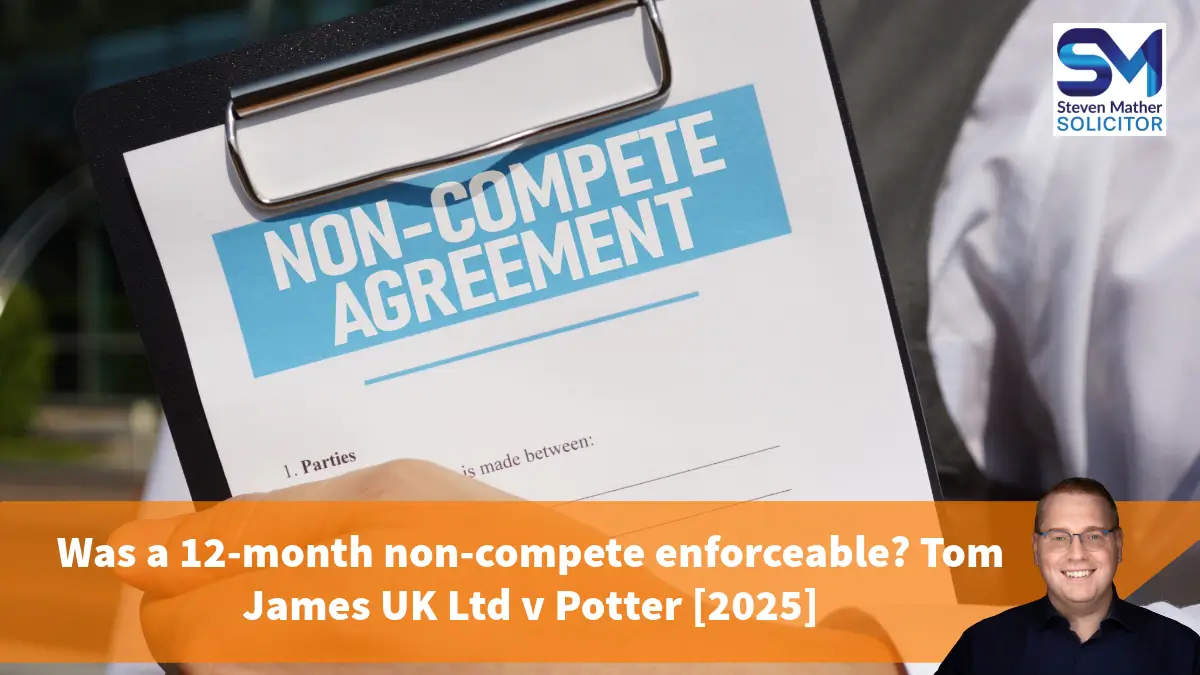
When an employee leaves and goes to a competitor, emotions often run high. Employers want to protect their client base and confidential information. Employees want to move on and use their skills. The question is: where’s the line?
The recent case of Tom James UK Ltd v Potter [2025] EWHC 2873 (Ch) looks at exactly that. It’s a detailed judgment that explores how far an employer can go when enforcing a restrictive covenant, and where “protection” tips into “unreasonable restraint of trade”.
The background
Mr Potter worked as a salesman for Tom James UK Ltd, a made-to-measure clothing business. He sold bespoke suits and shirts to clients across London, visiting them in their offices and homes. He wasn’t in management or strategy – just a skilled front-line salesperson with his own client list.
He resigned in 2025 after a series of disputes with management. The company suspected he was planning to set up on his own and took him to court to enforce a non-compete clause that stopped him working in competition for 12 months after leaving.
They also accused him of breaching duties of fidelity and confidentiality.
What the employer claimed
Tom James said that:
-
Potter had access to confidential client lists, pricing and sales information;
-
He’d been in contact with other staff and customers about competing, and
-
The company needed a full year to rebuild relationships with its 400+ customers.
They relied on a restrictive covenant that had been expanded in a 2022 contract – doubling the non-compete from six to twelve months and removing geographical limits (so it no longer just covered London).
What the employee argued
Potter denied any wrongdoing. He said:
-
He’d never poached clients or staff;
-
His role was purely sales, not strategic or managerial.
-
The confidential information he held was limited to his own customers, not trade secrets; and
-
The 12-month restriction was excessive, especially given his one-month notice period.
He also pointed out that he hadn’t been told the new contract had stricter covenants when he signed it in 2022 for only a small pay rise.
What the court decided
After a five-day hearing, the High Court sided with Mr Potter.
The judge found that:
-
Potter had not breached his duties of good faith, fidelity, or confidentiality;
-
He hadn’t solicited customers or colluded with others.
-
His stress-related absence was genuine, and
-
The restrictive covenant was unenforceable because it went further than was reasonably necessary to protect the company’s interests.
The clause was too broad in duration, geographic scope, and role coverage. It even prohibited working “in any capacity” for a competitor – which could include being a receptionist or driver.
The court also noted that Tom James had given no evidence to justify the need for 12 months, especially since other salespeople had left and joined competitors after six months without problems.
Even though some vague words could technically be “blue-pencilled” (removed), the judge said the covenant as a whole was too wide to be saved.
Why this case matters
This judgment is a clear warning to employers who use off-the-shelf or overly broad non-compete clauses.
Restrictive covenants must:
-
protect legitimate business interests, such as customer connections or confidential information;
-
be no wider than necessary in time, geography, or role; and
-
be tailored to the individual employee’s position.
Courts will look closely at what the employee actually did, what information they had access to, and whether the employer could have used less restrictive measures (for example, company-issued phones or non-solicitation clauses).
For employees, it’s reassurance that the law will not let employers prevent fair competition – but it also highlights the need to understand and negotiate these terms before signing.
The takeaway
This case doesn’t mean non-competes are dead. They can still be enforced – but only when they’re reasonable and justified.
If you’re an employer, make sure your contracts are properly drafted and updated to reflect real commercial needs. If you’re an employee, take advice before agreeing to restrictions that could affect your next job or business.
If you’re dealing with a non-compete clause, restrictive covenant or confidentiality dispute, I can help you review, negotiate or enforce your agreement.
I also regularly draft and advise on employment contracts, consultancy agreements and confidentiality clauses – all in plain English.
📞 Contact Steven Mather, Solicitor, for straightforward advice on employment restrictions and business protection.
